An Image of a Wheat Field in North America
The EmigrantsAn Image of a Wheat Field in North America is the picture that gives Karl Oskar Nilsson’s hopes of emigration a concrete form. For a farmer whose labor has not overcome Korpamoen’s stones, debt, and uncertain harvests, the picture is more than an illustration: it is evidence, in his eyes, that another kind of soil and another future exist.
The Picture in the Cottage
After breaking a plow on a stone-bound field, Karl Oskar returns home rather than going to his workbench. He looks at the unplowed rye stubble, then carefully takes out a paper borrowed from the churchwarden. Wiping his fingers on his trousers before touching it, he handles the sheet with the care of a valuable document. His attention settles on the picture titled “A Wheat Field in North America.” The contrast is immediate: outside the window lies the difficult field he must work; on the page is a harvest landscape that seems to answer the failures of his own land.
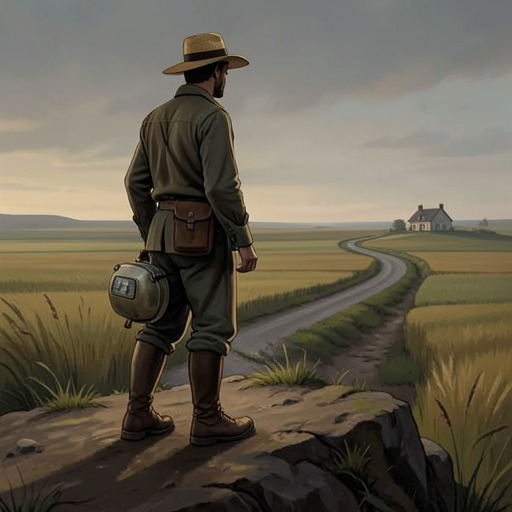
The pictured field is level and without visible boundaries, stones, or hillocks. Its shocks stand close together, their sheaves heavy with full-grown wheat. The description expands the harvest into an almost limitless store of food: golden grain reaches toward the horizon, and the shocks seem like waves across a sea. For Karl Oskar, this is not simply abundance in the abstract. It is a field without the obstacles that frustrate his work in Korpamoen, and a vision of bread produced in a quantity he cannot imagine at home.
Image as Evidence and Promise
The picture matters because Karl Oskar trusts what he sees more than a story or verbal account. A tale might be invented and a description mistaken, he reasons, but a picture shows what exists. The image therefore turns North America from a distant name into a verifiable place in his imagination: if such a field has been pictured, its soil and crop must be real. His response is reverent; he studies the paper quietly as though following a hymn in church. The image becomes an object of belief as well as a source of practical hope.
A printed statement beneath the picture says that farmers willing to work have great prospects of future success in the United States. This wording joins the pictured harvest to the value Karl Oskar places on labor. Yet his experience has already unsettled the belief that effort alone guarantees a livelihood. After three years at Korpamoen, he and Kristina have worked to the utmost and still have one fewer cow and seventy riksdaler more debt. Four years into their life there, they are several hundred riksdaler poorer than when they began. The image offers no proof that hardship will vanish, but it makes the possibility of work yielding a different result seem credible.
Soil, Faith, and the Decision to Leave
The picture’s force also comes from the novel’s contrast between Old World and New World soil. Karl Oskar sees the ground in the Old World as cursed because of humanity, while the New World’s earth still appears blessed. The endless harvest image gives this spiritual distinction a material shape: fertile soil, abundant grain, and the prospect of bread stand against stony fields and repeated setbacks. The image does not itself settle the family’s decision, but it helps make migration thinkable as more than an escape into the unknown.
In the evenings, Karl Oskar and Kristina discuss the move and what each of them feels. His reasons are grounded in the future he fears at home: continued labor without improvement, followed by old age with little to show beyond the reserved room and meager maintenance owed to his parents. The North American field stands in sharp opposition to that prospect. It offers a horizon beyond the small farm’s limits, while the family’s later preparations reveal how cautiously they must approach that horizon. They pack tools, food, bedding, and clothing into a single chest and carry provisions for the journey; hope in the pictured abundance does not remove the practical burdens of reaching it.
From Vision to Material Journey
The picture’s imagined open ground contrasts with the emigrants’ departure from Korpamoen, where the old and young are divided between those left behind and those setting out. Karl Oskar looks back at Nils and Märta standing on the porch, and the image of them fixed there becomes an enduring memory. The New World picture points forward, but leaving home also makes loss visible: the family cannot take its former life with it, even as it carries tools and household goods toward another one.
That tension between departure and continuity recurs in the objects the emigrants bring. The old family chest, once used across generations for clothing and belongings associated with baptisms, weddings, and funerals, is repurposed as an America chest. Tools are packed for work in the new land, while the family also takes bedding, food, and the bridal quilt. The picture’s promise of abundance is thus joined to an inventory of what survival will require and what the family chooses to preserve.
The novel’s later use of Swedish soil at sea burials gives the contrast between homeland and promised land a more somber material counterpart. During a burial, the captain takes earth carried from Sweden and scatters three scoops over the covered body; some of it later slips into the sea. The wheat-field image had made distant soil a sign of possibility, but the voyage also makes homeland earth something carried, rationed, and ultimately lost. In this way, the picture’s significance is not that it guarantees success. It gives Karl Oskar an image strong enough to challenge the closed future of Korpamoen, while the emigrants’ departure and burial rites keep the cost and uncertainty of that hope in view.